
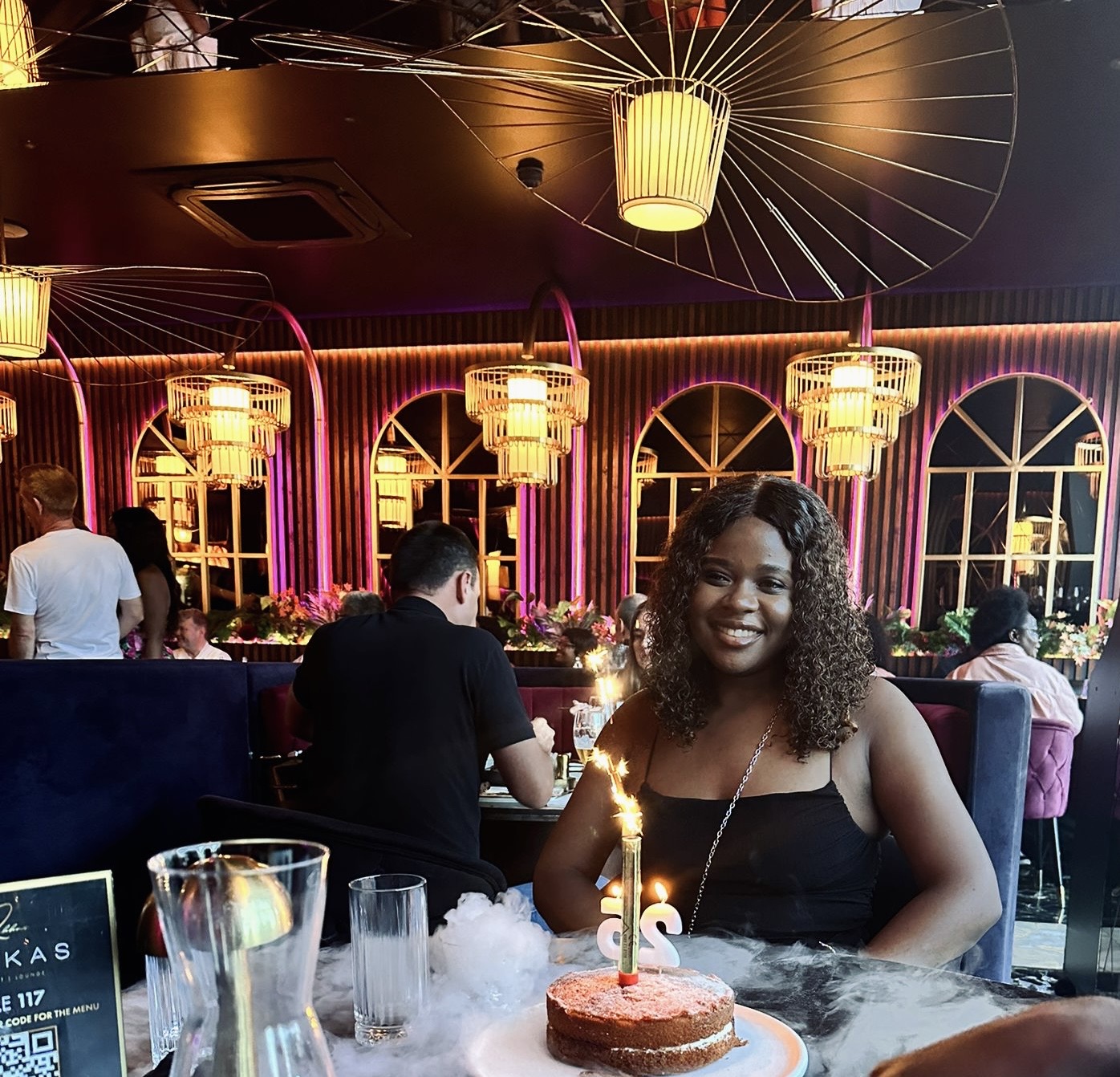
On 8 August 2024, I reached the milestone age of 25. This birthday felt particularly significant, not just because it was my silver jubilee but also because it reflected the transitions I was undergoing. I was transitioning from my early 20s to my mid-20s, from living in student accommodation to living in a flat (and paying utility bills – yikes!), from being a full-time student to being a full-time worker. It was definitely a huge moment for me.
For a long time, I’ve had a very specific plan for my life: Study law at university, go to law school, get a master’s degree. When I was about to start my master’s programme, I started to slightly panic. I was finally nearing the end of the road: What next after master’s? Would I apply for a PhD immediately or take some time off studying to work full time? Would I go down the corporate law path, or delve into research, or maybe even take the NGO path like my parents? I dabbled into a lot of different things alongside my studies – law firms, NGOs, legal advice clinics, think tanks. But where would I end up? I was very unsure.
Currently, I am at a place where I feel like the trajectory of my life has been going in one specific pattern, and it’s a culmination of all the various experiences I’ve had over the last few years, both within and outside my control. These experiences have taught me many important lessons, which I summarise in seven points below.
1. Every opportunity serves as a stepping stone.
When I say that the trajectory of my life has been going in one specific direction, I am referring to the fact that every opportunity I’ve gotten has served as a stepping stone for the next stage in my life – whether I knew it or not.
I will give you two examples. The first comes from the work I did when I was in Nigeria. I never meant to work while I was in law school; it just sort of happened because my resumption date was postponed due to COVID. An opportunity arose for me to work in the meantime, and I took advantage of it without even thinking about how it would help me in the future. I carried on working while I was in law school, and it turned out that if I had not gotten this job, I would not have even been eligible to apply for my master’s programme, which required a two-year work experience. So, without me knowing it at the time, this opportunity was crucial for my next step.
A second example comes from my work placement in London. As part of my master’s programme, I was required to undergo a three-month placement, ending in December. I carried on with the placement the next year even though I didn’t have to, because I thought it would be a good opportunity for me. Little did I know that a member of the team in that organisation where I did my placement would be on the interview panel for my next job – where I am currently working. He later told me that he also spoke to the director of my placement organisation – whom he knew personally because they had worked together – and the director had good things to say about me. So simply carrying on with that placement served as a stepping stone for my next stage. If you had told me in December 2023 that continuing with that placement would help me with my next job in such a direct way, I would have been surprised.
In fact, there are many more examples, including the fact that I got an academic editing opportunity towards the start of my master’s programme, which not only positioned me well to excel in my own master’s thesis but also enabled me to stand out in the application process for my current job. Space will not permit me to delve fully into all these examples, but the point I’m trying to highlight is that every opportunity serves as a stepping stone for the next stage, even though it might not be apparent immediately. This is why it is so important to always make the most of every opportunity that comes your way, even if you don’t know exactly how it will help you in the future. When you are constantly grabbing opportunities, you will eventually see how each one links to the next, contributing to the overall trajectory of your life.
2. Everyone’s life path is different.
Another thing I’ve come to realise is that everyone’s life path is different – and that’s okay. There are times when I’ve doubted my life choices. I would see people who were the same age as me, or maybe graduated university at the same time as I did, doing big things. Meanwhile, I was still battling law school exams in the – for lack of a better word – uncomfortable village of Bwari.
But it was a process that I had to go through for my life path. If I hadn’t gone back to Nigeria for law school, I would not have had certain opportunities that became available to me in the two years I was in Nigeria. And the opportunities I gained in those two years were essential to getting me to where I am today, in terms of both work and studies. So I have no doubt that the path I am currently on is as a result of all the experiences I’ve had in these last few years. And I couldn’t have gotten to where I am any sooner.
At the same time, this point shows that life is not a competition. At every single point in time, no matter what you are doing, there will always be people who are further ahead of you and those whom you are further ahead of. That is the reality of life. So when you are looking at other people and trying to compare yourself to them, remember that they are on their own life path with their own timeline – focus on yours. It’s not a matter of age or who you went to school with. What you need to ensure is that where you are is in accordance with your own life path.
3. Confidence is key.
When I say confidence is key, I mean you should be confident about your knowledge and skills – your ability to do things well. And on this point, I’m speaking to myself as well, because I sometimes struggle with imposter syndrome. I have moments where I doubt my skills and knowledge, and I need external validation to reassure me of my value. But at the end of the day, the people who get the jobs, the scholarships, the grants, the contracts are not always the most knowledgeable or skilled people; they are simply the ones who are the most confident about their skills and abilities and are able to sell this narrative well.
It’s easy to see that everyone has at least some level of skill and knowledge. But who is going to get the opportunities? It’s the person who is able to sell themselves well. If you constantly doubt yourself, someone else who isn’t even as qualified as you will get the opportunity you want because they are more confident and better able to sell themselves. In fact, you may not even apply for the opportunity in the first place if you don’t feel confident about your skillset. And in so doing, you have automatically eliminated the possibility of getting that opportunity.
Overall, I think it’s fair to say that the most confident people are not always the most qualified, so it’s important that those who have the skills and knowledge are actually able to back it up with the appropriate level of confidence. Be confident – to a delusional level, if you must – about your skills and abilities, so that you can package yourself into an asset and be well positioned to get the opportunities you want.
4. Your network is everything.
The older I get, the more I realise just how important your network is. I can’t lie – I still have a long way to go in improving my networking skills, but I’m a lot better than I used to be. Your network will bring so many opportunities to you – collaborations, jobs, ideas, even just advice. If you have a rich network and you are able to leverage it, you are well positioned for success. So it’s really important to be intentional about networking.
At a minimum, utilise LinkedIn in your networking. For me, I did not only find the ads for my two most recent jobs on LinkedIn; I also got a placement opportunity without even trying, simply by connecting with someone on LinkedIn, who read my profile and reached out to me to offer me the opportunity. I’m not saying this sort of thing always happens on LinkedIn, but at the very least, it can help you expand your connections and find relevant opportunities. Imagine how much more you can do when you combine using LinkedIn with leveraging your offline connections.
5. Money is never enough.
I’ve written previously that no matter how much money people have, it never seems to be enough to meet all their wants. The more money you have, the more your desire to spend increases – it’s an unending cycle. The more I progress financially, the more the practical reality of this situation dawns on me. Lamide Elizabeth explains this point excellently, referring to it as the trap of lifestyle inflation:
Lifestyle inflation is where your expenses are constantly growing as your income grows. For example you get a pay rise and suddenly you feel entitled to spend that extra amount on upgrading your car, phone or apartment.
Many of us go through this when we start our first full-time job. With that first ‘adult paycheck,’ it’s normal to see your expenses go up. Maybe you finally move out of your parents’ house or start shopping where you’ve always wanted to. We work to give ourselves a better standard of living and I believe my money is meant to be enjoyed.
So how can you avoid the trap of lifestyle inflation? I think the idea is simple, really: When your income increases, continue living the way you were living previously. Don’t move into a more expensive flat or buy a more expensive car. Instead, save and invest that extra income.
But putting this idea into practice is much harder than it sounds. And it’s not completely unreasonable to want to upgrade your lifestyle when your income increases. I definitely share Lamide’s sentiment that my money is meant to be enjoyed. However, I think the key point is that upgrading your lifestyle to the point that you have nothing left in your account at the end of the month – or worse, before the month ends – is simply unwise. What makes more sense is setting aside a healthy chunk of that additional income for savings and investment, and then you can use whatever is left to treat yourself.
Personally, I’m convinced that no matter how rich you are, your money can never be enough to meet your infinite list of wants. But that’s okay, because as long as you’re disciplined enough, you can pay your bills and build your savings and investments while still enjoying the money you work hard for.
6. It’s okay to ask for help.
I’m someone who likes to figure things out on my own. If I’m trying to achieve something – whether it’s getting a new job, finding a new place to live, or getting a grant – I’m very unlikely to ask for help with the process. I will only tell you when – or if – I was successful. But I recently learned that sometimes it’s okay to ask for help. I’m not saying broadcast your problems to the entire world, but if you have trusted people around you who can help (e.g., your parents, your partner, your sibling), then you should ask for help if you need it.
And I’m not necessarily talking about financial help. I’m also talking about help in the form of advice. Have you ever been in a bad situation and realised that it could have been avoided if you had just asked for help? Sometimes, in your desperation to figure things out all on your own, you end up doing things against your better judgement, especially if you’re running out of time. But in those moments of desperation, just speaking to a trusted person can help you think more clearly, gain a little perspective, and decide on the next steps to take. Asking for help when I need it and realising that I don’t always have to figure everything out on my own is definitely something I intend to work on going forward.
7. Be your unique self!
My final bit of advice is to be your unique self! I’ve always joked around that different people bring out different versions of me. However, I think on some level that situation stemmed from me feeling self-conscious about how certain parts of my personality will be perceived by certain people. But the older I get, the more I’m learning to embrace every part of myself, including – maybe even especially – my quirks and imperfections. At the end of the day, if you are always conscious of how people will perceive certain parts of you, you will end up stifling parts of your personality just to please others, which is simply not worth it. These unique things are what make you who you are, and you have no reason to want to stifle them. So ditch the self-consciousness, and be unashamedly you!
Ultimately, I can’t believe how blessed I am for the incredibly amazing and unique opportunities I’ve had in my 25 years on Earth. I know now that all of my previous experiences have been preparing me for my present ones, whether I knew it or not. From my law school resumption being postponed due to COVID to juggling work and study, from enrolling on my master’s programme to starting my placement, from working part time as an academic editor to going full time into legal research, each experience has been preparing me for the next one. Of course, there are still so many unknowns about the future, but I couldn’t be more happy with where I am today, knowing fully well that my current experiences are equally propelling me for the next stage of my life. Cheers to new milestones!
Do any of these lessons resonate with you? Let me know in the comment section!
Enjoyed this post? Hit the ‘Subscribe’ button below to get notified of new posts via email!
Discover more from KIKI
Subscribe to get the latest posts sent to your email.
 KIKI
KIKI 